

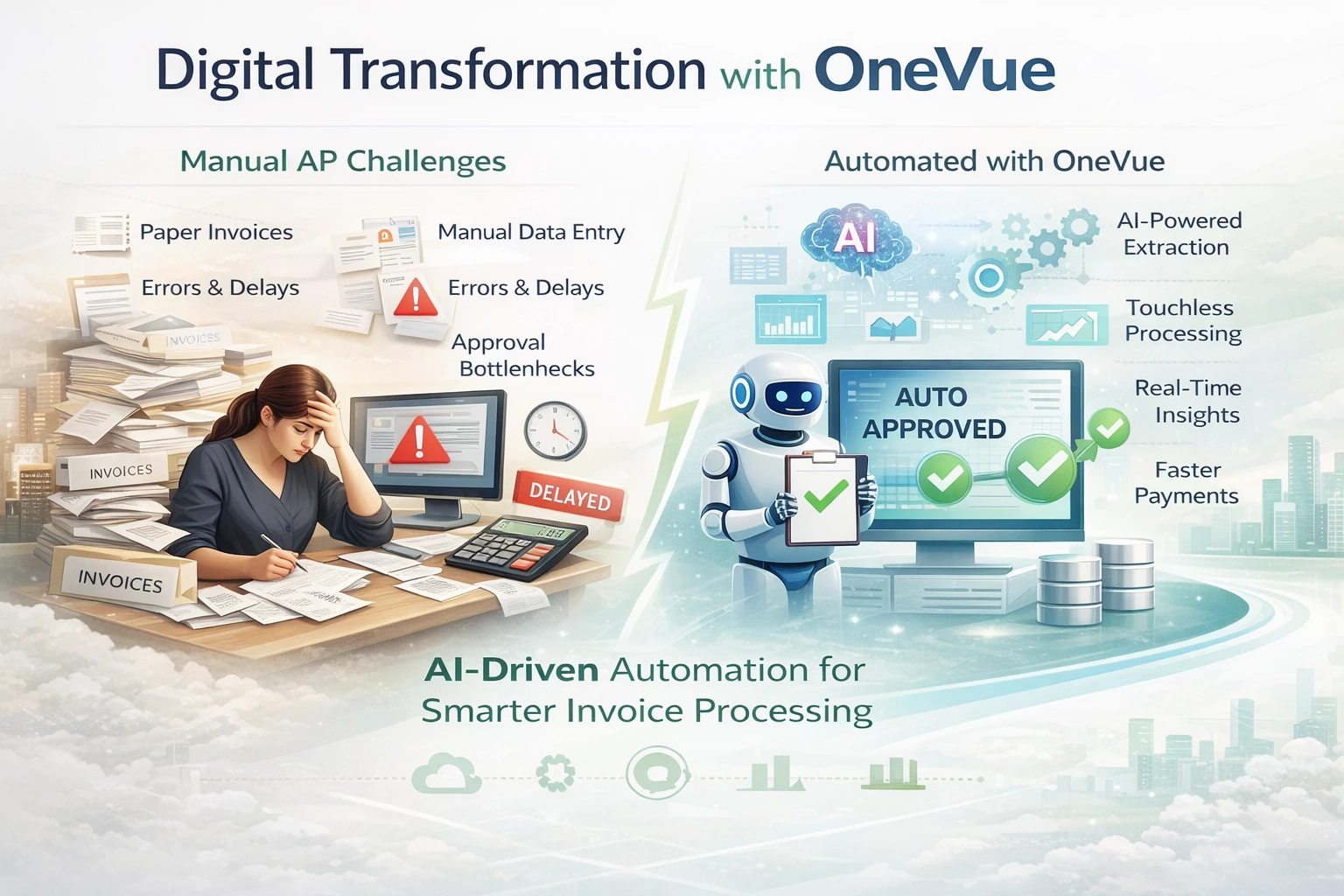
For decades, accounts payable has been one of the most resilient pockets of manual work inside large enterprises. Despite waves of digital transformation, many AP teams are still manually keying invoices, chasing approvals over email, and reconciling mismatches by hand.
The question isn't why this persists: it's why the typical "automation" tools haven't solved it. The answer lies in the gap between what vendors promise and what enterprise environments actually demand.
“The team isn't failing. The process is.”
The Hidden Cost of Manual AP
It's easy to underestimate the true cost of manual invoice processing. Beyond staff time, manual AP creates cascading inefficiencies that ripple through your entire finance function.
These are not just operational inconveniences. They are strategic liabilities that undermine financial visibility, vendor relationships, and audit readiness.
3 Problems That Still Exist (Even After "Automation")
Many organizations have deployed OCR tools, RPA bots, or basic workflow platforms, yet still find their AP teams under pressure. Here's why.
OCR Accuracy Issues
Traditional OCR relies on template matching. When a vendor changes their invoice layout, extraction breaks. High exception rates funnel straight back to your AP staff. Modern AI-powered extraction understands invoice structure contextually, without needing templates.
Rigid Rules-Based Matching
Rules-based systems are brittle by design. Partial PO matches, multi-line invoices, and tax discrepancies all create manual touchpoints. AI-driven matching learns from pattern history and handles ambiguity with configurable confidence thresholds.
Peak Load Failures
Month-end is the moment AP accuracy matters most, and exactly when manual processes collapse under volume. Cloud-native AP platforms scale elastically, processing thousands of invoices concurrently without degradation.
What Changes with AI + Cloud
The combination of enterprise AI and cloud-native architecture resolves each of the above problems, not through workarounds, but through structural redesign.
- ✓Contextual AI extraction reads invoices the way a human does (understanding layout, intent, and field relationships) without vendor-specific templates.
- ✓GenAI policy configuration lets AP managers define matching rules in plain language, removing IT dependency for rule engine changes.
- ✓Cloud elasticity ensures quarter-end surges are absorbed automatically, with processing capacity scaling in real time.
- ✓Real-time ERP write-back means approved invoices flow directly into Oracle EBS, PeopleSoft, or Fusion: zero re-keying, full audit trail.
From Reactive to Predictive AP
The greatest strategic shift AI enables in AP isn't speed: it's predictability.
When your process is reactive, you're always fixing problems after they've occurred: duplicate payments discovered in audits, vendor disputes from processing errors, cash flow surprises from invisible AP liabilities.
OneVue Invoice in Practice
OneVue Invoice is Ecovue's enterprise-grade AP automation application, built specifically for Oracle ERP environments: E-Business Suite, PeopleSoft, and Oracle Fusion.
Key Capabilities
- ✓Native integration with Oracle WebCenter Imaging and WebCenter Content
- ✓AI-powered extraction with GenAI-assisted policy definition, with no templates required
- ✓3-way and 4-way PO matching with configurable tolerance thresholds
- ✓Real-time write-back to Oracle ERP with full audit trail and GL coding automation
- ✓Human-in-the-loop verification workflow for high-value or exception invoices
- ✓Cloud-native and scalable, handling millions of invoices monthly without performance degradation
The AP Team Isn't the Problem: The Process Is
AP professionals aren't inefficient. They're operating inside processes designed for a world before AI, before cloud, and before the document volumes modern enterprises generate.
The organizations that will win in the next five years are those that stop treating AP as a back-office cost center and start treating it as a strategic financial intelligence function.
The tools to make that transformation exist today. The question is whether your organization is ready to deploy them.